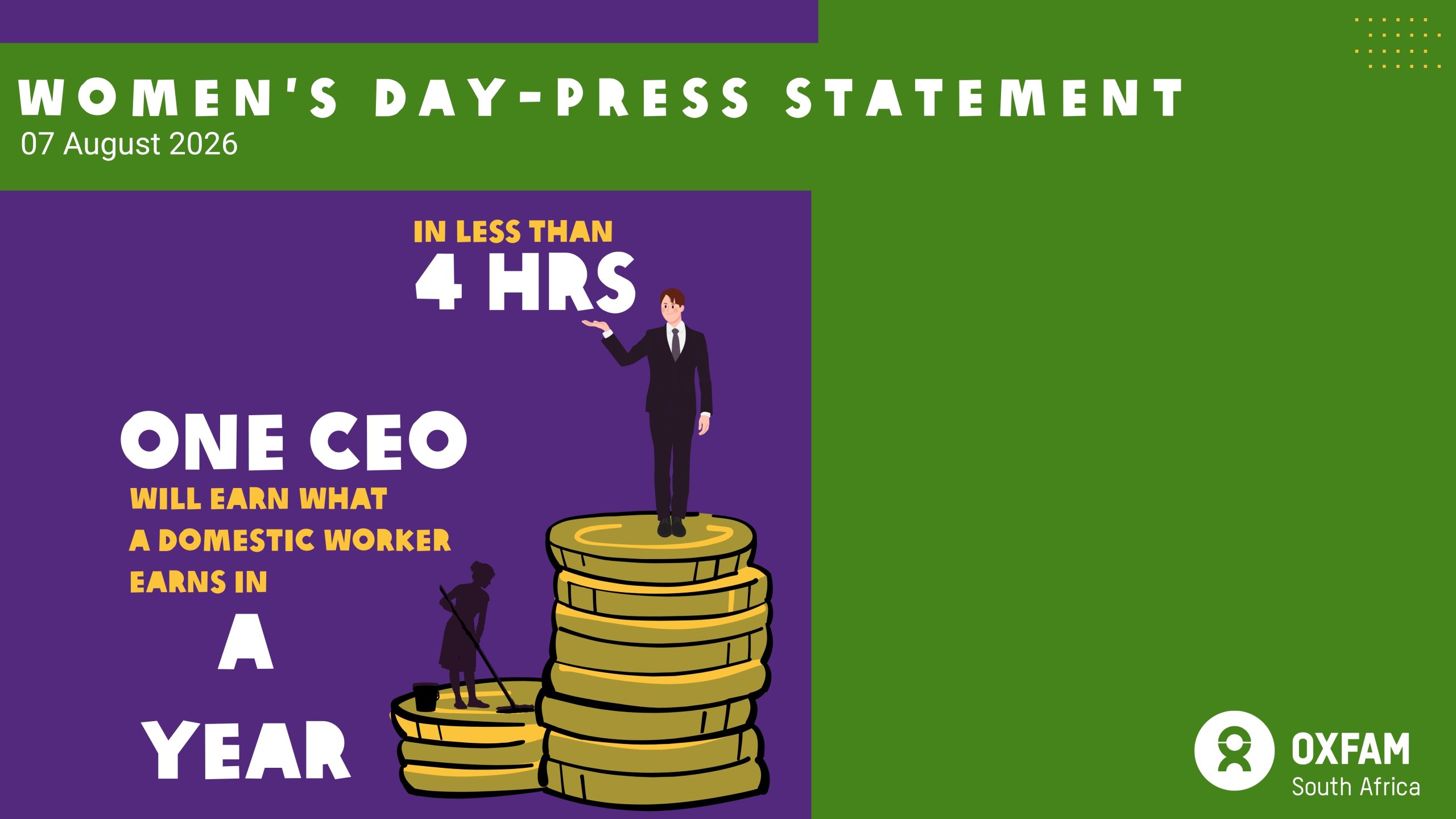
Women’s Day Press Statement: In Less Than Four Hours, One CEO Will Earn What a Domestic Worker Earns in a Year
Attention: Editors
Date: 7 August 2026
Women’s Day Statement: In Less Than Four Hours, One CEO Will Earn What a Domestic Worker Earns in a Year
Women carry the greatest cost of South Africa’s inequality.
In less than four hours today, one top CEO in South Africa will earn what a domestic worker earning the minimum wage will earn in her entire year.
This stark comparison exposes the scale of inequality that continues to shape South Africa’s economic system. It reveals how extraordinary wealth can accumulate at one end of society while the work that cares for the families of the CEOs, cleans the corridors of power, and cares for our elderly remains persistently undervalued. Seventy years after the Women’s March to the Union Buildings, economic justice remains unfinished business for millions of South African women.
The women who marched in 1956 demanded dignity, justice and equality. Seventy years later, those demands remain unmet, not because women lack rights under the law, but because too many still lack equality in the economy and so, in society.
A crisis that wears a woman’s face
South Africa is among the most unequal countries in the world, and that inequality has a distinctly gendered dimension. Women continue to experience its consequences more acutely, not because they contribute less, but because the structures of our society continue to value their work, time and opportunities less.
Women are more likely to be unemployed than men. Those who are employed continue to earn substantially less than their male counterparts. Women and girls also spend more than twice as much time on unpaid care and domestic work, sustaining households and communities in ways that remain largely invisible to the formal labour market and are rarely recognised in economic decision making or how the economy is measured.
For millions of women in South Africa, inequality is not an abstraction. It is the daily reality of choosing between transport to work and food for children. It is the exhaustion of juggling paid work, unpaid care, and the constant struggle to make ends meet. It is the knowledge that even when they work, they are valued less, paid less, and offered less security than their male counterparts. It is in the fact that poor women can apply for social grants for their children, but not for their own needs. Their reproductive function is recognised, not their own inherent dignity.
At the same time, violence against women also has a deep correlation with inequality. It is a manifestation of unequal power and one of the ways in which power is reproduced and maintained.
An economy still shaped by its past
South Africa’s inequality did not emerge by accident. It was built over generations through colonialism and Apartheid. And despite important democratic gains, too many of those economic structures remain intact.
The legacy of exclusion remains deeply entrenched. The richest 1 per cent of South Africans now own 55 per cent of the country’s wealth, up from 49 per cent at the end of apartheid, while the poorest half of the population continue to have negative net wealth, with debts exceeding their assets. The gender wealth gap is 35%, meaning that on average women have 35% less wealth than men. Black households own just 5 per cent of the wealth held by white households, reflecting generations of unequal access to land, assets and opportunity. At the same time, Women, particularly Black women, bear the heaviest burden of these intersecting inequalities.
This is not a story of individual success or failure. It is a story of a system that continues to concentrate opportunity, wealth and power in the hands of a privileged few, while millions of South Africans, especially women, remain excluded from access to the benefits of growth and prosperity.
From awareness to action
This Women’s Day, we cannot afford to treat inequality as merely a statistic to be noted or a problem to be studied. In the G20 Inequality Report commissioned by President Ramaphosa last year, inequality was declared an emergency. It was recognised as a crisis that is undermining the rights, dignity and wellbeing of millions of people in South Africa, eroding our democracy and retarding economic growth.
South Africa has the resources, the institutions and the policy tools to change course. What has been lacking is the real political will and courage of our leadership to use these tools to change the lives of people today and to make better futures a reality for today’s children, especially black girl children, tomorrow.
First, South Africa must tax extreme wealth fairly.
The super-rich have benefited enormously from the country’s economic growth while contributing proportionally less in taxes. Much more progressive taxation on wealth, capital gains and inheritance, combined with closing the loopholes that allow the wealthy and corporates to avoid and even evade tax could raise billions in additional revenue to fund public services and social protection and reduce the extremes of inequality. This approach has broad public support, including among South African millionaires, the overwhelming majority of whom support higher taxes on the very wealthy to fund public services and address the cost-of-living crisis.
Second, South Africa must invest boldly in the care economy and in quality public services.
Healthcare, education and social protection are not costs to be contained; they are investments in a more equal and prosperous society. Government must strengthen these public services while recognising, rewarding and redistributing unpaid care work so that women are no longer expected to subsidise society through invisible and unpaid labour.
Third, South Africa must build an economy that works for women.
This means expanding access to decent and secure work, closing the gender pay gap, protecting labour rights, strengthening collective bargaining, making streets and homes safe and ensuring that gender equality is embedded across economic policymaking, rather than treated as an afterthought.
An unfinished struggle
As we mark Women’s Day, we honour the women who marched in 1956, not by celebrating how far we have come, but by recognising how far we still have to go. The struggle for economic justice is the unfinished business of South Africa’s democracy.
Oxfam South Africa is currently undertaking broader work examining the structural drivers of inequality and the policy choices needed to build a more equal society. Today’s statement reflects that continuing work and the organisation’s commitment to ensuring that economic justice remains central to South Africa’s future.
Commenting on Women’s Day, Pooven Moodley, Acting Executive Director of Oxfam South Africa, said:
“The measure of any economy is not how many billionaires it creates, but whether the people whose work keeps that economy functioning can live with dignity. Women in South Africa have carried the costs of inequality for generations. Confronting the systems and structures which perpetuate inequality for women will ultimately shift towards freedom from exploitation and violence. Women’s Day should remind us that the struggle for equality did not end with formal political democracy. It simply changed shape.”
Seventy years ago, women marched because they refused to accept that inequality was inevitable. South Africa faces a different but equally urgent challenge today. Whether we choose to build an unsustainable economy that rewards extreme wealth, or one that values dignity, fairness and opportunity for all, will define the next chapter of our democracy.
-END-
For media enquiries or interview requests, please contact:
Amir Bagherioromi
Media and Campaigning Officer
amir.bagherioromi@oxfam.org.za
+27 74 422 2647
Notes to editors:
- The CEO compensation figure used in this statement is based on the median total remuneration for CEOs in the JSE Top 40, which was R21.3 million in 2025.
- Domestic work remains one of the largest sources of employment for women in South Africa and continues to be characterised by low wages and limited economic security.
- The domestic worker annual wage is based on the 2026 National Minimum Wage of R30.23 per hour for a 45-hour working week, totalling R70,732.80 per year.
- South Africa has 8 billionaires, all men, with a combined wealth of R730 billion.